Showing posts with label Egypt. Show all posts

Tuesday, July 9, 2013

POV: Rocks And Hard Places

Photo © Max Lee-All Rights Reserved

I occasionally depart from opining on photography or on stuff that piss me off...but this time, this POV is personal.

Egypt, my country of birth, is once again facing an incredibly dangerous phase in its 7000 years' history. I've spent most of my life elsewhere, and while perhaps in some ways that detaches me from it, I still have a connection. Seeing the current turbulence on the various television channels and reading the news articles enhances that connection, and whatever my current emotions are, they're based on the residuals gleaned during the earlier years of my life.

As everyone knows, there are three main power centers in Egypt at this time: the 'street' who's had enough of  authoritarian regimes but is ill-organized, the military and the Islamists/Muslim Brotherhood...both well organized.

I've already expressed my views on the removal of Morsi from the presidency in other forums, so I won't repeat them here....but in summary, my view is that he deserved his removal due to his administration's abysmal record during the past 12 months, and Egypt can ill-afford suffering another 3 long years of this terrible governance.

My personal position is this: I don't want a religious clique to govern Egypt...I don't want them to impose their interpretation of Islam on anyone....whether Muslim, Christian, Jew, Baha'i, Shia, Sufi,  agnostic or atheist...I don't want them to impose a style of dress on women...I don't want them to tell women to stay home and not work....I don't want them to interfere in anyone's personal or public life...I don't want them to claim 'jihad' for any cause they deem appropriate to sully Islam further...I don't want them to influence education (already bad enough) in Egypt...I don't want them to tell anyone what to read or not to read...to view or not to view...I don't want them to discriminate against anyone...against any gender or lifestyle....

With the 'street' as disorganized as it is, lthis eaves the military as the only, and potentially temporary, viable alternative. I'm uncomfortable with that option...very uncomfortable. But the military -while execrable when confronting threats to its authority- is more interested in administering its industrial complex and business interests than interfering in daily life....and having a political role distracting them from their lucrative activities.

Eventually, the 'street' will mature, get organized and rise to the task of democracy...and perhaps the military will then cede the reins. Perhaps the youths of the Muslim Brotherhood will remove its current old ideologues and reshape themselves into a constructive political party.

Friday, April 19, 2013

Egypt's St. Anthony Monastery | Manoocher Deghati

Photo © AP Photo/Manoocher Deghati-All Rights Reserved (MercuryNews.com)
Through Zite, I stumbled on this very interesting photo essay about the Monastery of St Anthony in the Egyptian Eastern Desert. It's a Coptic Orthodox monastery lying deep in the Red Sea mountains, and about 200 miles southeast of Cairo. It is one of the oldest monasteries in the world.

The photo essay was featured by MercuryNews.com, and the photographs are by Manoochar Deghati, a well-known Iranian-French photojournalist, and also the brother of Reza, an Iranian-French photographer.

The monks at the St. Anthony's Monastery follow the saint's ascetic tradition, but even they won't be silenced amid the Islamists' rising power.

I think the MercuyNews.com reportage is quite timely in view of the recent attacks on Egyptian Christians caused by the increase in bigoted religious rhetoric by Islamists. Clerics and others on religious television channels in Egypt spread much of the bigotry and discriminatory rhetoric, and despite claiming to be otherwise, members of the Muslim Brotherhood and its political arm, have stigmatized religious minorities, particularly Copts.

Christians or Copts form more than 10% of Egypt's population of 85 million, and lived largely peacefully alongside Muslims for more than a millennium. Sectarian tensions have steadily risen over the past four decades, and the prominence of the Islamists and the Islamist government raised tensions further, have exacerbated the sectarian frictions.

The Copts are the native Christians of Egypt, and are a major ethno-religious group in Egypt.  Christianity was the majority religion during the 4th to 6th centuries AD and until the Muslim conquest of Egypt.

Saturday, February 9, 2013

Roy Gunnels | Cairo's Al Muizz Street

Photo © Roy Gunnels-All Rights Reserved
Almost every morning, I scour news websites for updated news on Egypt...my birth country that is experiencing an extremely painful transition from authoritarianism to a sort of chaotic "democracy".  Every day, I read of (and see) examples of incompetence in governance, anarchy, street level anarchy, human rights abuses, violence, economic melt-down, emergence of black markets, capital flight, political paralysis, religious zealotry and antediluvian ideology, sexual harassement, discrimination, civil disobedience, institutional rot and corruption...the list is too long, where do I stop? It has gone for bad to worse...and the end is not in sight.

And yet, Egypt has -over the eons of its existence- survived it's ups and downs...but this time it seems that its luck may have run out. It was better when I grew up there...but it was still better than that when my parents grew up, and it was even better than that when their parents grew up...it's a downward spiral.

I recall walking reasonably recently in Al Muizz street in the medieval section of Cairo...a literal stone's throw from the famed Al Azhar, the Muslim center of learning...so I was glad to have found Roy Gunnel's photographs of that particular street titled A Pastiche of The Street . The street is about one kilometer long and houses shops of traditional wares.

Its full name is a mouthful...it's named after  El Moez Lel Din'ellah, a Fatimid (969-1171) ruler famed for his enlightened rule, and was renowned for his drive to build monuments, mosques and other buildings.

As my readers will see, street photography here is incredibly rewarding and rich of daily life. Another of my favorites (apart from the one above) is the one of a antique store keeper rubbing his toes, with his back turned to an ancient gramophone.

Roy Gunnels is a documentary and fine-art photographer from Fort Worth. He worked the past few years in the Middle-East and Africa while based in Cairo, Egypt. He was profiled and his work from the streets of Cairo featured in The Guardian, as well as the Egyptian Midan Misr newspaper, and the Atlantic Council’s ‘Egypt Source’. His images from the Egyptian Revolution of 2011 have been recommended for exhibit at the World Peace Center in Verdun, France.

Friday, July 6, 2012

Xenia Nikolskaya: Dust, Egypt's Forgotten Palaces

Photo © Xenia Nikolskaya-All Rights Reserved

From afar, it seems Egypt and its people are still waiting to exhale since its popular uprising against the Mubarak regime, and 60 years of dictatorships...and whilst I try my best to counter the lay neo-cons and the agenda-driven commentators who write absurd comments about its current events and future in The New York Times by writing my own points of view (and they all get featured without fail), I fear the internal political situation in Egypt is murky, and will remain unsettled for the near future ...and that's an immense understatement.

So Xenia Nikolskaya's work on the UK's Daily Telegraph suffused me with mixed feelings. Dust is a good title for her photographs of buildings built after the Suez Canal opened in 1869, and before Nasser came to power in 1954, introducing sequestration decrees that would send many of the wealthy elite into exile.

The buildings, mansions, movie theaters, and retails stores that are depicted in Xenia's Dust have mostly fallen into disrepair. Due to long standing governmental rent-control policies, these once ornate and grandiose buildings were left to rot, with no repairs or maintenance done, as landlords weren't making money from them.

I recall the names of some of them....Radio Cinema ( I watched movies there, at a time when I was careful to count my change as the women at the ticket had the habit of "rounding" it in their favor), Sakakini Palace, Sarageldine Palace, while others are unknown to me.

Xenia Nikolskaya graduated from the Academy of Art in St Petersburg and then went on to study at the Royal Danish Academy of Fine Arts, Copenhagen. She has worked as a professional photographer since 1995, and became a member of the Russian Art Union in 2001. She first came to Egypt in 2003 as part of a Russian archaeological mission.

Wednesday, May 23, 2012

NYTimes: Moises Saman's Egypt's Choice


Presidential election fever has been gripping Egypt for months, and it'll perhaps come to a conclusion in the coming few days...or in another few weeks, if a runoff is the case.

Along with many millions of Egyptians, I couldn't believe my eyes when watching the first ever presidential debate in the Middle East took place earlier this month. Yes, it was flawed...yes, the two frontrunners went overboard in hyperbole and off topic attacks one each other... but nowhere else in the Arab world, has such a spectacle ever been seen before.

Yes, Egypt's political transition has been farcical, messy, bizarre, chaotic, violent, unpredictable, and serious, ....however after centuries of Pharaonic kingdoms, various foreign occupations, colonialism,  royalty and dictatorships, Egyptians were now experiencing the teething pains of democracy. I raise my hands in wonder when I read articles by educated journalists and pundits who claim that after 30 years of Mubarak's regime, Egypt is experiencing democracy. It's not 30 years...but over 2500 years!

In recognition of this critical milestone in Egypt's (and in the world's) history, I feature Moises Saman's Egypt's Choice as published in The New York Times.


Monday, April 16, 2012

18 Days In Egypt


A power struggle of epic proportions between various political factions is currently underway in Egypt...essentially a troika of conflicting interests, the power struggle is manifesting itself overtly and covertly. Overtly, the battle for power is over the presidency, and is between the Muslim Brotherhood, (a comparatively pragmatic Islamic movement) the Salafists (a regressive Islamist faction), and the military establishment. The secular forces seem to have been marginalized, even though it was its youth who sparked and carried through the revolution in 2011.

That said, it's not over till the fat lady sings...and there will be more twists and turns to this story as it enfolds over the days and weeks to come.

I thought the 18DaysIn Egypt documentary being worked on by filmmaker and journalist Jigar Mehta is working on a new kind of documentary is especially timely in such a fluid political situation. It's a crowd-sourced interactive documentary project aimed at capturing the history of the revolution in Egypt.

The context of this documentary is simple enough. In the 18 days of Egypt's uprising that began on January 25, 2011 and that ended with the resignation of Hosni Mubarak, thousands of Egyptians turned to their cell phones, digital cameras or social media sites to document the events unfolding in Cairo and across the country.

Tapping into this wealth of material, American documentary filmmaker and journalist Jigar Mehta co-founded 18DaysInEgypt.

Sunday, February 12, 2012

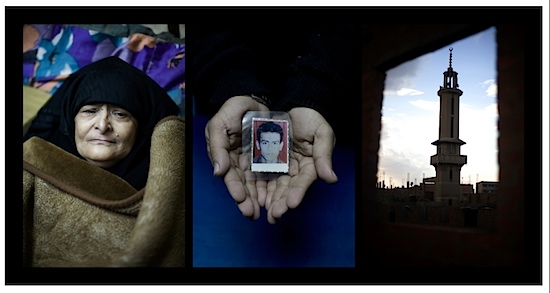
Nadia Shira Cohen: Egypt, The Burned Earth

Photos © Nadia Shira Cohen-All Rights Reserved
“Mohammad, Mohammad, Mohammad,” she muttered. The words escaped just slightly under her breath as the tears began rolling down her face.

It's been a year and a day since Hosni Mubarak was forced out of office by the Egyptian people, and I thought it worthwhile to feature the work of Nadia Shira Cohen, which appeared in The New York Times a few days ago.

Her work focused on the Egyptian victims of the country’s so-called emergency law, principally by talking with them first, and then by photographing them.

Whilst Nadia's photographs and synopsis of her conversation, or interviews, with a handful of these victims appear on her website, her photographs also appear on the The New York Times' LENS blog.

All of her interviews are painful to read...but I thought the most poignant was that of the mother of Mohammed Attiah, who's bedridden with grief at the disappearance of her son some 18 years ago at the hands of the Egyptian police.  She has never stopped saying his name since then.

Nadia Shira Cohen pursued her passion for photography at the University of Vermont, with a semester abroad at the SACI school in Florence, Italy. She worked as a photographer in New York City for the Associated Press and for Sipa Press.  She then went on to work at the VII photo agency, then moved Rome, Italy where she continues to tell stories of the lives of people who interest her and which she compassionately feels the need to expose.

Sunday, January 29, 2012

POV: Lost In Translation?

Photo © AP Photo/Muhammed Muheisen- Courtesy DenverPost.com
I've seen quite a few errors in the captions of photographs recently, but this one is probably the most misleading. The photograph appeared in the Pictures of the Week on the Denver Post Plog

Underneath the photograph is a caption that reads "Eman Mohammed, 7, holds a placard that reads in Arabic, "our army is over our head, and the parliament belongs to the ousted," during a protest in Tahrir Square, in Cairo, Egypt, Monday, Jan. 23, 2012. The parliament elected in Egypt's first legislative vote after Hosni Mubarak's ouster nearly a year ago held its inaugural session on Monday, with Islamists dominating the 498-seat chamber that will oversee the drafting of a new constitution."

This is incorrect, and is at a 180 degrees divergence from what is on the placard. The correct translation of the Arabic words on the placard is "Our Army is over our head (ie a colloquialism for being held in great esteem)...The Council belongs (or follows) the ousted (for the ousted Mubarak)."

The Council referred to on the placard is not the Parliament, but is the Supreme Council of the Armed Forces. This is totally divergent from what the caption incorrectly states. The child is presumably one of the protestors who took part in a demonstration against the military council, not against the civilian Parliament.

I always wondered whether in such a case, would the error be that of the photographer (in this case, an Arabic speaker) or someone else?

Wednesday, January 25, 2012

A Year Ago...Egypt

Photo © Ed Ou - All Rights Reserved

In remembrance of those who fell in Tahrir and elsewhere. The Egyptian revolution started a year ago today, and is still ongoing.

And to the naysayers, neo-cons and the rest of the mindless individuals who prefer Arab dictatorships, and see democracy (as imperfect as it may be) taking its first steps in Egypt and the rest of the Middle East as an existentialist threat, go screw yourselves.

And to those who are optimistic, here are, via Foreign Policy Magazine, the young Egyptians who will eventually succeed in achieving what they started.

Friday, December 2, 2011

Ed Ou: The Egyptian Youth

Photo © Ed Ou-All Rights Reserved
The news that "Islamists" seem to have won a majority in Egypt's first Parliament since the ouster of Mubarak is being reported by the US media in disquieting vocabulary, especially since it came at the expense of the liberal parties and youth activists who set off the revolution.  Many secular Egyptians are expressing alarm and anxiety at the result of the initial round of Parliamentary elections, while others shrug off these results by predicting that the Muslim Brotherhood (as one of the factions described as Islamists) may well have a majority, but will either choose or be forced to exert its political clout in a moderate fashion.

Ed Ou has covered the momentous events in Egypt ever since the start of the revolution, and has recently featured his work in progress of The Egyptian Youth.

Ed is a Canadian photojournalist who has been working in the Middle East, former Soviet Union, Africa, and the Americas. He started his career as a teenager, covering the 2006 war between Israel and Hezbollah in southern Lebanon, and the fall of the Islamic Courts in Mogadishu, Somalia. He worked for Reuters and the Associated Press, and was also an intern at the New York Times.

He is the recipient of a Global Vision Award from POYi, a 1st Place Contemporary Issues award from World Press Photo, and other recognition from the Overseas Press Club, Ian Parry Scholarship, Best of Photojournalism, PDN Photo Annual, UNICEF, among others. He has been selected for a Getty Images Editorial Grant, PDN 30 Under 30, and took part in the World Press Photo Joop Swart Masterclass. He was recently awarded the City of Perpignan Young Reporter Award.

Tuesday, November 29, 2011

POV: Moises Saman And Cairo Undone

Photo © Moises Saman-All Rights Reserved  
How wrong I was! I always dismissed the idea of photographing street life in Cairo by saying that there was nothing to photograph there...not much color, no vibrancy....but that began to change after the January Revolution. Was it a subconscious rejection of the then-prevailing environment? Or simply because I was blase about photographing in my own backyard...albeit one that I left for more than 30 years? Was it both? Perhaps.

That admission being made, I have to clarify that I speak only of street life rather than particular cultural subject matters, such as documenting Sufi rituals such as those I photographed a few years ago.

What changed my mind is the brilliant photo essay in The New York Times titled Cairo Undone by Moises Saman.  The photo essay (it's really a gallery as there's no storyline nor timeline) is of snapshots (I use this term very respectfully) of daily life in Cairo...the gritty, the edgy, the incomprehensible, the political and the anachronisms that dominate this teeming city.

I intended to post this as soon as I saw the photographs, but I was in Siem Reap and just couldn't find the time. I have viewed and re-viewed this work many times, and it revived in me a hunger to document facets of this city. Is it a nostalgic yearning? I doubt it...I don't think that way. It's similar to my documenting the Sufi rituals in various countries...that is nothing more than an intellectual and aesthetic pursuit.

It's the same for Cairo...nothing more nothing less. But time will tell.

Monday, November 28, 2011

Miguel Ángel Sánchez: Portraits Of Egyptians

Photo ©  Miguel Ángel Sánchez-All Rights Reserved

Since elections are going full steam ahead in Egypt, The New York Times' Lens blog has featured Portraits of Egyptians, a series of wonderful photographs by the talented Miguel Ángel Sánchez.

I absolutely love seeing photographic work of that nature...ethnographic to a large extent, and produced by borrowing the techniques of the Old Masters. Miguel Ángel Sánchez photographed 110 residents of Cairo in his studio; these included musicians, painters, politicians, writers, bloggers, shoeshiners, doormen, and the vendor of flowers above, which is absolutely my favorite amongst all of them. My least favorite is that of Zahi Hawass, the ex-Minister of Antiquities, not because of the image but because of the man himself. I don't know the man, but I developed an antipathy for his brash behavior and loudness in National Geographic television specials (as an example).

You will not find the photograph of the flower vendor on the Lens blog, but rather it's on Miguel Ángel Sánchez website. The flowers she's seen selling are jasmine, which are popular in Egypt for the powerful sweet smell. I believe the jasmine flowers sold on string strands are called "fol", and are popular in Egypt to deodorize one's car or to gift to one's sweetheart while strolling the city's gardens.

But back to the LENS blog...a comment was rather critical of the photographer for choosing to depict the Egyptians in Renaissance settings. I disagree. In choosing the lighting and poses similar to those we have seen so many times in museums and galleries the photographer creates acceptability for his subjects to the Western eye.

Saturday, November 26, 2011

Global Post: Egypt's Women Of Revolution

Photo © Elizabeth D. Herman-All Rights Reserved

While I'm here in Siem Reap, I am following the events in Cairo with mixed feelings...feelings of pride and anxiety. The outcome of the 'rebooted' Egyptian revolution is impossible to predict, but some pundits have describe the current events in Tahrir Square as Egyptians trying to reclaim their January 25 revolution from the military.

There are a number of recent photo essays from Tahrir Square, but I thought I'd feature the work of Global Post's Elizabeth D. Herman titled Egypt: Women of the Revolution.

This is a compelling gallery of 18 photographs along with captions that tell us the back stories of each photograph. Last month, Elizabeth Herman spoke to 13 Egyptian women about the media’s coverage of women’s involvement in the Egyptian revolution. Their roles were varied, as were their experiences and reactions to the revolution, with some having actively joined the movement and others forced to do so by circumstance. All have much to say about how it has affected their lives, and how their experiences are similar to — and different from —those of other Egyptian women.

As is customary whenever readers' comments on the news of the Egyptian revolution appear in The New York Times, Islamophobia and political agendas raise their ugly heads. Comments describing the Egyptian revolutionaries as 'savages', and others hoping that the upheaval would not harm Israel (presumably this being much more important than Egyptians having basic human rights) are sent to the newspaper and published without consideration.

And, of course...we have some of the US press indulging the American proclivity for inward introspection, narcissism, and insularity. Just take a look at TIME's cover for its US edition as compared to the rest of the world's.


Both hilarious and sad at the same time.

Wednesday, November 2, 2011

Tomas Munita: Egypt's Discontent

Photo © Tomas Munita-Courtesy The New York Times

Tomas Munita's photographs of Cairo are dark, saturated, brooding and shadowy. One of them shows a couple of policemen peering through the rear window of a bus parked near a mosque in a Cairo tourist area...and to my mind, an analogy of the current situation in Egypt. Shadowy powers, whether military or otherwise, incapable or unwilling to act.

The accompanying article by Neil MacFarquhar paints a bleak picture of a revolution that, after having taken the world by storm, has now stagnated...and is seemingly going nowhere.

Paralyzed by the weakness of a caretaker government that takes its marching orders from the shadowy military rulers known as the Supreme Council of the Armed Forces, Egypt's economy is heading nowhere...and that's a charitable way of saying it. Stuck in an outdated autocratic mindset, the civilian and military authorities are both unwilling and incapable of instituting any meaningful societal and economical change.

The article quotes Emad Shahin,a professor at Notre Dame University as saying “Egyptians said they had a leaderless revolution, and they were so happy about it then. They are now paying a price for that.” In theory, perhaps that's true.

I watch the unfolding events in Egypt as most others do...with dismay and sadness. All I see for the time being for Egypt is what we witnessed in Myanmar. A subservient "civilian" government controlled by a shadowy military institution, or an outright military take-over of the government. As the fable goes, a wolf in sheep's clothing is still a wolf.

Egypt deserves an infinitely better future.

But back to photography. Compare Tomas Munita's photographs to Jehad Nga's work (mentioned earlier on this blog).

Sunday, October 23, 2011

Jehad Nga: Cairo Corners

Photo © Jehad Nga-All Rights Reserved

One of my favorite photographers is Jehad Nga, and I've featured his work on many occasions on The Travel Photographer blog for his superb chiaroscuro work, for his distinctive photographic and visual style and for his choice of subject matter.

In recent interviews, Jehad shared that he was no longer interested in editorial work, but I'm glad he decided to feature recent work on Cairo on his website. Those who know his work will realize that the Cairo work is, in a way, more art than documentary-editorial.

There are two galleries relating to Cairo; one of which is Cairo Corners, in which his trademark unabashed shadow-play is clearly evident.

"I respond more to fashion and fine-art, carrying these fields and variables in photojournalism." -Jehad Nga

On a personal note...I've been urged by a number of Egyptians to photograph my homeland, and even to lead photo workshops there...not necessarily in Cairo, but to outer regions such as Siwa for example, which boasts a distinct culture. Such a workshop may well occur in the near future, especially as I pore over Jehad's beautifully crafted images. Is my hesitancy to photograph in Egypt caused by what I call the "native's blind eye"? I don't know....but Jehad's work certainly inspires me to see Cairo in a different light.

Wednesday, August 24, 2011

Yuri Kozyrev: On Revolution Road


With the fall of Libya's regime, I thought I'd feature Yuri Kozyrev's On Revolution Road, a reportage on the past months' uprisings in the Middle East against the sclerotic and despotic regimes that governed these countries for decades.

Kozyrev's focus was on the youthfulness of the revolutionaries, their clever use of social media websites, their embrace (for the most part) of nonviolent protests as a political tool.

As an award-winning photojournalist for the past 20 years, Yuri Kozyrev has covered every major conflict in the former Soviet Union, including two Chechen wars. Immediately after September 11, 2001, he was on the scene in Afghanistan, where he documented the fall of the Taliban. He spent much of the past eight years based in Baghdad, as a contract photographer for TIME Magazine. He has traveled all over Iraq, photographing the different sides of the conflict.


AP Photo/Alexandre Meneghini
I also thought I'd feature this priceless image of a man, wearing a t-shirt with the design of U.S. flag, taking part on Friday prayers at the main square of the rebel-held town of Benghazi, Libya, on August 12, 2011. It's part of a larger gallery in The Atlantic's In Focus.

Monday, August 1, 2011

Egypt's Revolutionaries: Platon Style

Photo © Platon-Courtesy The New Yorker
The month of Ramadan has dawned on the Islamic world, and I thought I'd mark the event by posting Platon's images of the Egyptian revolutionaries, and in so doing wishing the Egyptian people a future they want and certainly deserve.

Be sure to view the accompanying short videos. You'll first have to suffer Goldman Sachs adverts, but just close your eyes while they play.

According to the news, Hosni Mubarak, his two sons, former interior minister Habib el-Adli, six of his aides and businessman Hussein Salem, are all charged with being involved in the killing of protesters during the 18-day revolt.

I'm not optimistic that the trial will be a speedy one, nor thorough. I wouldn't be surprised at all if it's postponed for a myriad of reasons...but the Egyptian people will eventually get justice. They must.

Wednesday, June 29, 2011

Mugur Vărzariu: Egypt Adrift

Photo © Mugur Vărzariu-All Rights Reserved
Mugur Vărzariu is a photojournalist based in Romania whom I met at the Foundry Photojournalism Workshop in Istanbul. I discovered he started as a photographer less than four months ago before attending the workshop, and it seems he has been extremely busy since then.

He traveled to India, Syria, Libya as well as Cairo, where he documented facets of the Egyptian Revolution in a photo essay titled Egypt Adrift, which is perhaps an apt description of the current development. I hope he's wrong, but so far it does appear that the ideals and values of the youth of Tahrir may be tossed to the side by the current "transitory" authorities.

One of the photographs in his Egypt Adrift essay is of a red car, with hood open...presumably stalled and needing fixing. It made me laugh, since the graffiti on the left of the frame says "The Central Security Forces robbed this store" with an arrow pointing to the shuttered store. The Central Security was the much hated entity used in suppressing any dissent, and was used to brutalize those who didn't toe the ex-regime's line.

I wonder what Mugur, being from Romania which suffered greatly under Nicolae Ceaușescu, felt documenting the Egyptian Revolution, which has some parallels to his country's December 1989 overthrow of its own dictator.

Tuesday, May 3, 2011

Marty Stalker: Egypt-After The Revolution


Here's an impressive documentary on Egypt during the heady days immediately following the revolution, filmed by Marty Stalker. Marty is a writer/director living in Northern Ireland with a passion for film-making. He recently graduated from the Lights Film School in New York City.

His Vimeo page informs us that the documentary was filmed on the Canon 5D Mark II with Zeiss compact prime Lenses in March 2011, and edited in Adobe Premiere Pro CS5 with Magic Bullet Mojo.

You can read Marty's notes on its production on his Scattered Images website.

The yells of the crowds one hears in the opening few moments of the movie are interesting since these are "Here's The Thief" (presumably about Mubarak), and "We Want Our Money". I liked how grainy black & white newsreel-like clips were inserted among the main colored movie. I am certain you'll be impressed by Dr Kamal Aboumagd, the wise constitutional lawyer, a gentleman who, in his demeanor and style, exemplifies the Egyptians of yore.

Well done.

Friday, April 8, 2011

The Revolution Thru The Lens of Fady Ezzet, An Egyptian Photojournalist


I've featured the work of young Egyptian photojournalists working for the local newspapers, who not only documented the Tahrir uprisings, but who also participated in the revolution.

For why I'm doing this, you can read my earlier post The Revolution...This Time Through The Lenses Of Home-Grown Egyptian Photojournalists.

This is the fourth and last part in the series, and is the work of Fady Ezzet, an Egyptian photojournalist who also works for El Shorouk Newspaper. He graduated from Cairo University, and is a full time photojournalist.

Having followed the series, I noticed that Fady's images are more in the thick of violence than the others. I presume being a male allowed him to take more risks than the other three women.

For each slideshow in the series, I chose the popular "Enta Omri" or "You Are My Life" from the repertory of the legendary Um Kulthum, the Egyptian singer who was the incomparable voice of her country. I owe the idea to a wonderful multimedia essay titled Spring by Shirin Neshat in the New York Times, who also used it as a metaphor for the revolution.