Showing posts with label POV. Show all posts

Saturday, November 2, 2013

POV: Analog Efex Pro


I'm perennially looking for short cuts when I post process my photographs. I use minimal processing whether using Photo shop or Lightroom (with the exception of sharpening, and adjusting levels and curves, I rarely use the other tools), and sitting at a computer fiddling for hours on end for the optimal look is really not my kind of thing...I just don't enjoy it.

Coming up with my own presets is above my intellectual pay grade, so I am always thrilled to find software that provide "one-click" solutions.

I'm particularly fond of Alien Skin Software and of the Nik Collection, and use them whenever necessary. These alternatives often preclude me from having to use Photoshop, and I'm delighted.

The Nik Collection from Google has received a new free update which is named Analog Efex Pro – a series of filters that replicate the look of classic cameras, wet plate cameras, toy and vintage...all 'funky' presets that alter the character of ones' photographs at the click of a button.

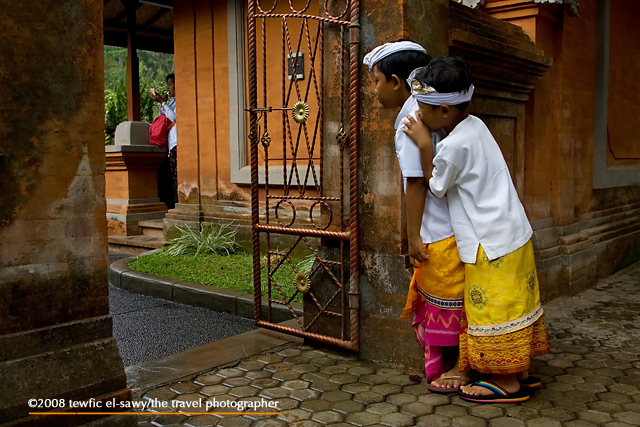
For the portrait of the young Balinese student dancers, I chose a colored wet plate look which replicates the look of ancient color photographs of the Italian photographer Felice Beato (1832-1909).

Wednesday, October 23, 2013

POV: Sadhus, Charlatans or Not?

Photos © Tewfic El-Sawy-All Rights Reserved

Yesterday's post prompts me to elaborate a bit more on the question whether the sadhus in India (and Nepal) are charlatans or a genuine aesthetics.

From my numerous travels in India over the past 10+ years, and from having met innumerable sadhus during my assignments and photographic expeditions, I'm reasonably comfortable in asserting that most of them are a cross between homeless charlatans and spiritual ascetics. The more difficult question is whether they became ascetics because of poverty or because of some form of inherent spirituality. Charlatanism is an integral part of many of them, but they may have resorted to this activity because of need.

With their tilak markings, and their orange cloths, they are certainly photogenic and some of them exploit their appearance to coax money from gullible (and sometimes, not-so-gullible) tourists. Others are more imaginative, and develop an aura of spirituality to generate religious respect and alms from lay people.

Naturally, there are a large number of sadhus who are authentic. For instance, the Naga Babas, whose ceremonial bathing at the Kumbh Melas is a sought after ceremony, belong to the Shaiva sect and are known as 'warrior ascetics'.

In 2006, I've come across authentic sadhus during an assignment in Varanasi. My fixer was from this ancient city, and knew it inside out. Upon learning that I was interested in sadhus, and seeing my disinterest in photographing the "tourist" sadhus basking in the sun on the ghats of Varanasi, he took me to a number of out-of-the-way ashrams for sadhus.

It's there that I met elderly sadhus, living in nothing more than cubicle-like tiny rooms and subsisting on small bowls of dahl and rice. These were true ascetics, who spent their days reading Hindu sacred scriptures, meditating and avoiding contact with lay people as much as possible.

I recall one of them had come to Varanasi because it was where he'd be eventually cremated and cast in the Ganges, thus achieving moksha. That in itself is not unusual, but what was unusual was his background.

He had spent his whole career with the Indian Railways (the largest employer in India), and upon his retirement he chose to become an ascetic, and left his family with their full consent, leaving all his worldly possession and his pension. He came to his ashram, and started to study herbal medicinal plants. Eventually, patients came to seek his advice, and the word spread amongst the poor in Varanasi that he was a healer. He dispensed his advice for free, and occasionally accepted some food as payment for his services.

During my visits to these ashrams, I was never asked for money...no one offered me ganja...and no one asked to pose for my cameras...and certainly no one spoke English. One of the sadhus (the one reading a scripture) never even looked up to acknowledge me as I was photographing him.

Monday, October 14, 2013

POV: DxO Film Pack 3 & Color Efex Pro 4

All Photos © Tewfic El-Sawy-All Rights Reserved
I admit it...sheepishly perhaps, but I really do.

I've mellowed and moved away from my earlier resistance to experiment with what I call funky experimentation on my photographs. I was an unwavering believer in "purity" insofar as my photography was concerned, preferring to keep my photographs as untouched as possible.

As recently as a year ago, I would use Photoshop or Lightroom as minimally as possible, barely using their capabilities except for some sharpening and color enhancements. But the availability of specialized post processing software such as DxO Film Pack, Alien Skin Software, and Color Efex Pro 4 encouraged my explorative forays into different creative avenues, and I developed an affinity for the wet plate look (quite obviously influenced by the Hipstamatic Tintype filter)...which in turn led me to try fiddling with some of my photographs using the previously mentioned software, either singly of together. Importantly, these software products are really no-brainers to use, and produce good results.

I'm still a conflicted purist at heart. For example, I'm unwilling to crop my travel photographs but I'm perfectly happy to crop the heck out of a photograph which I shot from the hip during my street photography jaunts in New York City. The fact that I shot an image from the hip gives me the "excuse" to crop it...but not for those I made using a viewfinder. So yes, a conflicted purist...or perhaps a purist who follows his own rules which he makes up as he goes along. Whatever.

This morning, I experimented with using the DxO Film Pack converting the lower photograph to monochrome (using the Kodak T-Max100 preset) and then applying a Sepia Gold toning filter to it. I then added some Structure and Vignetting using Color Efex Pro 4. I showed if off on my Facebook page...some friends liked it, so I used the same "soup" on the top two.

It took me no more than 3 minutes to process each photograph...and I quite like the results. Will it become one of my "signature" looks? I don't think so...I'm just having fun. That's the whole idea.

Tuesday, August 13, 2013

POV: Monochrome...A Phase In Life?

Photo © Tewfic El-Sawy-All Rights Reserved


A Facebook "conversation" touching on the merits (or lack thereof) of the Leica Monochrom with my friend Pierre Claquin triggered many thoughts in my mind. First off, the ephemeral thought of selling some or all of our photo gear to acquire the $8000 Monochrom crossed our minds...but after pushing away the temptation, I reflected on the reasons behind my recent interest in making monochrome photographs.

It started off during my Kolkata's Cult of Durga Photo~Expedition & Workshop™ in October 2011 during which I asked all its participants to produce their projects in black and white in order to bast capture the grittiness of Kolkata's Durga Puja.

I started to dabble with the various techniques in Photoshop or Lightroom; sometimes using presets in some cases. I also tried shooting in black and white with my M9 and the X Pro-1. The latter was used quite a lot in that mode in Sa Pa and Hanoi during my North of the 16th Parallel Photo-Expedition/Workshop, resulting in The Indigo People, and Hanoi Streets among others.

Photo © Tewfic El-Sawy-All Rights Reserved

More recently, I caught myself converting some of my most colorful photographs (such as the one of the Rajasthani shepherd and the Kathakali performer) to black and white, and was glad in seeing that these were equally powerful and pleasing to my eyes. I continued this trend over the past weeks, and started sending some of my conversions to be printed at Adorama.

In my office, I have about two dozen of some of my Cibachrome photographs made about a decade ago, already framed and mounted, and I've now decided to replace them with more recent photographs in monochrome. I already have switched 3 or 4 and these adorn one of my walls.

So is this infatuation with monochrome a function of a maturing phase in my photography timeline...or is it just an aesthetic phase that will subside? I don't know, but I wager that I'm not the only one who's passing (or has passed) through it.

It might also be a partial consequence of having downloaded the Nik Collection with its Silver Efex 2 software. The ease to use this software, and its results are really worth its $150 price tag.

In fact, its suggested workflow is what I use...not necessarily on all my conversions, but with a little tweaking, I found it works for me:

1. Apply Raw Presharpener using Sharpener Pro 3.0.
2. Apply noise reduction using Dfine 2.0.
3. Control color and light using Viveza 2.
4. Apply filter enhancements using Color Efex Pro 4.
5. Convert to black and white using Silver Efex Pro 2.
6. Apply output sharpening using Sharpener Pro 3.0.

Finally, will I desert color photography for monochrome? No...how can I when there are many instances where color photography is just perfect for the scene?

Photo © Tewfic El-Sawy- All Rights Reserved


Sunday, August 11, 2013

POV: Addicted To Auto-Focus

Photo © Tewfic El-Sawy- All Rights Reserved (Leica M9/Elmarit 28mm. f2.8 1/750)

I'm not sure how other photographers and photojournalists feel, but I've become addicted to auto-focus, and it's an addiction I find extremely difficult to shake off.

When I'm in the mood, I roam the streets of New York City and try to capture something of its essence. When I do this I generally shoot from the hip to catch the candid moment, the posture, the fleeting expression...sometimes I'm successful, and many times I'm not; but that's what candid street photography is all about. The probability of catching these candid moments is quite low.

It's for that reason that I favor the Fuji X Pro-1. There's a lot to favor in the X Pro-1, but its (relatively) good auto-focus is one of its advantages. Yes, it goes to "sleep" once in a while and makes me miss the shot...and yes, its AF is not as quick as a DSLR, but it performs as well as I expected it to.

My other street camera is the Leica M9 that has no auto focus, and I struggle to choose it over the Fuji X Pro-1 when I'm off to the streets. Don't get me wrong. Its image quality is fantastic, and although I'm not exactly a Leica fan-boy, I still think it's a phenomenal camera with phenomenal lenses...and is perfect for candid street photography (among other uses, of course).

But I hesitate when I reach for it.

Yes, I know all about zone focusing, and I practice it whenever I can. But it frequently lets me down, partly because of my addiction to auto-focus (ie using my X Pro-1) and partly because the nature of the type of shooting from the hip photography is a hit and miss process.

I've thought of an analogy to this addiction..and it's like learning to drive with a stick-shift car versus an automatic. It's been said that the former makes you a better driver, so when I reach for the Leica, I comfort myself by thinking that shooting without the auto-focus has its merits sometimes, despite rueing that decision when I see the eventual results.

Now, where's my iPhone? :)

Tuesday, July 9, 2013

POV: Rocks And Hard Places

Photo © Max Lee-All Rights Reserved

I occasionally depart from opining on photography or on stuff that piss me off...but this time, this POV is personal.

Egypt, my country of birth, is once again facing an incredibly dangerous phase in its 7000 years' history. I've spent most of my life elsewhere, and while perhaps in some ways that detaches me from it, I still have a connection. Seeing the current turbulence on the various television channels and reading the news articles enhances that connection, and whatever my current emotions are, they're based on the residuals gleaned during the earlier years of my life.

As everyone knows, there are three main power centers in Egypt at this time: the 'street' who's had enough of  authoritarian regimes but is ill-organized, the military and the Islamists/Muslim Brotherhood...both well organized.

I've already expressed my views on the removal of Morsi from the presidency in other forums, so I won't repeat them here....but in summary, my view is that he deserved his removal due to his administration's abysmal record during the past 12 months, and Egypt can ill-afford suffering another 3 long years of this terrible governance.

My personal position is this: I don't want a religious clique to govern Egypt...I don't want them to impose their interpretation of Islam on anyone....whether Muslim, Christian, Jew, Baha'i, Shia, Sufi,  agnostic or atheist...I don't want them to impose a style of dress on women...I don't want them to tell women to stay home and not work....I don't want them to interfere in anyone's personal or public life...I don't want them to claim 'jihad' for any cause they deem appropriate to sully Islam further...I don't want them to influence education (already bad enough) in Egypt...I don't want them to tell anyone what to read or not to read...to view or not to view...I don't want them to discriminate against anyone...against any gender or lifestyle....

With the 'street' as disorganized as it is, lthis eaves the military as the only, and potentially temporary, viable alternative. I'm uncomfortable with that option...very uncomfortable. But the military -while execrable when confronting threats to its authority- is more interested in administering its industrial complex and business interests than interfering in daily life....and having a political role distracting them from their lucrative activities.

Eventually, the 'street' will mature, get organized and rise to the task of democracy...and perhaps the military will then cede the reins. Perhaps the youths of the Muslim Brotherhood will remove its current old ideologues and reshape themselves into a constructive political party.

Saturday, June 22, 2013

POV: Religious Trances or Mental Disease?

Photo © Tewfic El-Sawy- All Rights Reserved- Photo Crop


In virtually all the Sufi dargahs I visited, from the shrine of Bahadur Shaheed in Varanasi to the one of Mira Ali Datar near Ahmedabad, I was stunned by the sight of women (a few men as well) entering into trances in front of the saints' tombs.

I initially thought these trances were caused by the religious fervor of these women, particularly in the ethereal "presence" of a saint...a syndrome colloquially called hajri. Being in a trance signified the entrance of the deceased saint in the body of the entranced person, to rid it from ailments, from jinns and other undesirable symptoms.

From my casual observations, these trances varied in their intensity from person to person. Some were completely oblivious of their surroundings, whilst others screeched and suddenly lunged at anyone who approached them with a camera. Some were accompanied by husbands, sisters and other family members, while others were alone.

At the shrine of Bahadur Shaheed, a woman supposedly in a trance tried to throw a rock at my head, whilst another in Mira Datar shoved me rather violently, and then apologized when she was out of her trance, saying she was unaware she did so.

I witnessed a significant number of women in the shrines of Srinagar sobbing and muttering supplications to the interred saints....but trances are different, and I concluded these are caused by mental disease.

Schizophrenia most commonly expresses itself as auditory hallucinations, paranoid or bizarre delusions, which may be what the “hajri” manifestations are. I’ve witnessed seemingly perfectly normal people arrive at these dargahs, socialize with their families and friends…then walking over to an area closer to the tomb itself, and slowly bring themselves to a crescendo of repetitive, and violent, erratic outbursts of physical activity that include rolling on the floor, banging their heads on pillars and walls, and swaying their heads from side to side.

If you look closely at the cropped image above, you'll notice that the arm of the woman in the trance bears scars that must've been caused by self-cutting. Self cutting is a symptom of borderline personality disorder, depression, anxiety disorders, post-traumatic stress disorder, and schizophrenia.

In India, poverty-stricken and superstitious people who suffer from mental illness frequently employ faith healing as an alternative to psychiatric treatment, and it is mostly those that I see at these dargahs.

Monday, June 17, 2013

POV: The Inle Lake Fishermen Are So Tired!

Photo © Tewfic El-Sawy-All Rights Reserved

I traveled to Myanmar (Burma) twice in 2001 and 2002. At that time, it was still very much "off the grid of mass tourism", and few tourists could be seen...either put off by the comparatively onerous entry requirements (and restrictive travel itineraries) or by their unwillingness to support the military junta, directly or indirectly. When I was in this lovely country, there was no internet as such (just a few approved businesses had it), no mobile telephony...but few cared. Burma and its people more than made up for these little inconveniences.

Recently the country has opened up and changed in many ways. Aung San Suu Ky was released from her house confinement, and her party won most of the seats in the lower parliament. Tourists are flocking in to the country as if these's no tomorrow...hotels are overbooked...flights are full and groups of Western and Asian tourists are spending time and hard currency to the benefit of the local Burmese.

This opening up has generated a lot of travel images by photographers...either on professional websites, or on social media. However, I haven't seen much of new approaches or fresh angles.

The photograph (above) of the Inle Lake fisherman I made in 2001 was from a pre-arranged photo shoot during which a few local fishermen would oar their boats not far from the hotel, and I'd photograph them from another rowing boat in the middle of the lake.

Most of what I see nowadays are photographs of for-hire fishermen photographed near the hotels' wharfs where the water is placid and calm...ideal for reflections and other cute stuff.

C'mon photographers...you can do better than that now. Photographs of the for hire fishermen of Inle Lake are a dime a dozen....and they all look alike. Who will buy them? Think of something else...another venue...go to the fishermen villages...produce a photo essay or an audio slideshow of their lives...be inventive and creative.

I've photographed the Inle Lake fishermen at dusk 12 years ago...12 years ago, and you're still photographing the same stuff?

You want ideas? Look at Sim Chi Yin's The Water Seller and Anthony Pond's The Ring Train of Yangon.


Sunday, April 28, 2013

POV: And Off I Go....


This ought to be the last blog post written in New York City as I'm flying to London, and on to Delhi to begin my two weeks Sufi Saints of Rajasthan & Kashmir Photo Expedition-Workshop. During this photo expedition, I shall keep my readers in the loop as much as I can.

I'll spend a few days in London where I have to look after some business, and I'm delighted to learn that The Natural History Museum is featuring the world premiere of Sebastião Salgado: Genesis, and which I'm planning to visit no matter whether it rains or the sun shines. He's one of my favorite photographers, not only for the beauty of his work but also because of his photographic philosophy.


Then it's a direct flight to Delhi where I arrive at 11:00 am on Friday May 3rd, and plan to meet with friends. I have much to do for the first few days prior to the arrival of the group of photographers who joined this workshop, and hope all will pan out as planned.


As is frequently the norm with my photo trips, the group members come from various corners of the world; the USA, the UK, Ireland, Bahrain, Denmark and Canada. 


Nine photographers all told...who, with their photographic and audio gear will work in Srinagar for 4-5 days in this unique Kashmiri city known as the land of Sufis Saints,  then to Ajmer in Rajasthan; the holiest of cities for Sufis, and where the shrine of the Sufi saint Khwaja Moinuddin Chisti, equally revered by Hindus and Muslims, will witness the commemoration of the death anniversary of the saint in unparalleled manifestations of Sufi fervor and devotion.

Photo © Tewfic El-Sawy-All Rights Reserved


I can't wait to photograph incredible people such as the Sufi punkhawallah above, and start producing audio-visual stories at these locations. My gear has been cleaned, lenses polished, CF and SD cards checked, and hard drives spun and re-spun.

India, here I come.


Saturday, April 20, 2013

POV: Missing The Right Moment

Photo © Tewfic El-Sawy-All Rights Reserved
We all have had these missed moments...and I have a lot of those, especially when I do street photography in the streets of New York City.

This one illustrates one of such missed moments...the choreography of pedestrians which could've  worked perfectly if the gods had been smiling, but they didn't...they frowned.

I estimated the walking pace of these two Hasidim on Avenue A would perfectly frame the woman crossing it, and snapped my iPhone shutter at what I took to be the right moment . But was not to be. The partially obscured man on the left who had been about to cross the street, suddenly stopped at this precise moment behind the second Hasidim. Damn!

Perhaps I was too quick...and should've waited for just a second or so. I might have caught the second Hasidim's shadow on the pavement, and the man might have decided to cross.  Just look at the shadow in the center...it looks like a bird.

But realistically, it would've been too late to catch the woman exactly where I wanted.

I looked at the display and I said...damn!


Thursday, February 28, 2013

Back Story I The Rajasthani Gypsy

Photo © Tewfic El-Sawy-All Rights Reserved
Dinesh Khanna's statement (see my previous post) of "color is almost a language in India" reminded me of one of my favorite color photographs.

So I thought of featuring it here with its short back story. It was made in 2003 with a Canon 10D (remember those?) and is of a Rajasthani gypsy couple I had met at the Phulad train station, which is near the small town of Jojawar, located between Jodhpur and Udaipur. I recall they had been waiting for a train to Pushkar.

I made a number of sequential frames of this couple, who were quite pleased to pose for as long as I wanted. Another frame (not shown here) is of the man hugging his wife with a broad grin on his face...I actually sold a number of the two versions to various magazines and travel catalogs in the UK.

Would you agree that it's the color vibrancy of the photograph rather than the expressions of the Rajasthani couple that made it attractive to these magazines, especially with the blue background?

But let's also view it in monochrome ( using a quick conversion method).

Photo © Tewfic El-Sawy-All Rights Reserved

Not as attractive as the color one, but still not bad. It being in monochrome perhaps focuses the viewer's attention to the couple's expressions...the squint of the man's eyes, and the women's awkward facial demeanor...and there's no blue background or pink turban to distract us....all we have left are the expressions and the man's regal allure. 

So in this particular case, I think the color photograph trumps its monochrome version...but as we know, black & white can be (and is) frequently more compelling than color. During my The Cult of Durga Photo Expedition for example, the group produced Durga Puja stories in black & white, to exploit the grittiness of Kolkata's streets...and in such an environment, perhaps shooting it in color would have been a distraction.

But wait! What about some artsy processing of the photograph by converting it to a "wet-plate" or "tin type"?


Does this artsy conversion trump the color version? I leave it to you to decide. As for me, I believe it certainly adds visual interest to what is a static portrait. It might qualify as "trickery"...but isn't photography itself a trickery of sorts?

I was very much against the concept of applying filters or manipulating photographs... even preferring not to crop or alter much at all from what I had captured in camera. But I've mellowed a little bit recently, and although 99% of my photographs will remain unaltered...there's room to do and enjoy stuff like the "wet plate" look.

Friday, February 15, 2013

POV: Are Ethnic Props Ethical?


Aaah! The Sports Illustrated Swimsuit issue is a big deal to some red-blooded males who wait for its publication with impatience...or so I'm told.

Be it what it may, for its 2013 issue, the magazine photographed models on all 7 continents, and its photographers used locals to appear next to these gorgeous women. Using ethnic people with colorful and indigenous costumes as extras for fashion shoots background is a popular gimmick used by photographers.

I have mild but still conflicting views about this. There's the extreme view as expressed by Jezebel, a blog which describes itself as the home for "celebrity, sex and fashion for women", that clearly finds this very offensive....and there's another view on the opposite side of the scale that sees this as nothing more than an innocent (and practical) gimmick used by photographers to add realism to their off location shoots.

Frankly, I don't find it offensive provided the local individuals who, in essence, are co-models should be told of the purpose of their involvement in the shoots, should be paid a decent salary for their time and should treated with the same respect than the models themselves. Recognizing their worth as co-models rather than 'props' is my stance on this issue.

Naturally, a "decent" salary is an elastic term...does it mean a salary or fee based on local tariffs...or does it mean decent by Western standards? I don't know what movie producers pay for their local extras, but I would hope that the "ethnic props" ought to be paid very handsomely by their country's standards.

It's not the first time I write about this matter, and haven't changed my mind since this blog post, which involved Jezebel and Marie-Claire magazine.

So food for thought...do you think Jezebel's stance is too extreme...is too political correct? Is it really exploitation...bad taste...even racist? What would you do if you could decide what to pay?

Saturday, January 26, 2013

POV: The Travel Photographer's Business Philosophy


I've been asked a number of times to share as to how it is that my Photo Expeditions-Workshops are consistently sold-out within a few weeks of being announced.

There are a number of reasons for that...some are no-brainers and others are more complex...these take dedication, research and commitment. But let's start at the top:

1. It's About The Brand.

There's the optics such as the brand name and trademark. I chose to become known as The Travel Photographer which is easily remembered, and perfectly describes what I do, leaves no room for confusion and is anyway easier to pronounce (at least for Americans) than my own name.

"Everything I do with my photography carries The Travel Photographer brand."


I've been using The Travel Photographer brand name, and its accompanying logo (simple, sober and solid) for about 8 years, so it's been in the public domain and has widely been around. It's not at all unusual for me to be accosted by other photographers who ask me "aren't you The Travel Photographer?"....and that's good....very good.

Everything I do with my photography carries The Travel Photographer brand...everything. The websites, the blogs, the galleries, and the photo expeditions-workshops...and of course, my newsletters.

I was perhaps the first who described what was originally peddled as 'photo tours' or 'photo trips' as 'photo-expeditions'. Semantics for certain, but it strengthens the branding impact of one's business.

Over and above the logo style, which as I described as sober, solid, and simple...like the logo for a well-established newspaper or bank for instance, the color schemes of my websites and blog also follow the same style. I believe it's not only my photographs and my style that defines me, but also the 'packaging'... there's a sort of consistency there, but without letting things go stale. Stylistic change is good, provided it's intelligent change.

2. It's About The Time.

I've been leading photo expeditions-workshops for more or less 10 years...and really worked at getting off the ground. As I wrote much earlier on this blog, it took off without me asking for favors, for free advertising, for referrals...I never did any of that. What I have accomplished is completely self-made and self-started.

I see many very experienced photographers suddenly getting involved in offering photo workshops, but  having difficulty in filling them up, despite their excellent body of work. It won't work without expensing the time, and effort to get a track record in leading such expeditions and/or workshops.

"What I have accomplished is completely self-made and self-started."


Yes, one has to use all the different types of social media...be it Twitter or Facebook, etc to spread the brand's visibility. However, I don't think I got a single participation from either of these two. Twitter and Facebook generate friends, a fan club or followers...but not necessarily clients.

The single-most source of participants for my photo expeditions and workshops is my blog, which is in its 5th year. Day in and day out...I post, keeping a tangible and intangible link with my current and future participants.  I've posted just over 3000 posts and reached the enviable (for a specialized photo blog like The Travel Photographer) number of 2 million readers since it started. That took time, effort, dedication and resolve.

From this blog, photographers subscribed to my newsletter, and are therefore keen to get details of my future photo expeditions-workshops. These are not followers, nor fans, nor friends asked to "like" my Facebook page, or Twitteratis. No, there are, for the most part, just interested in joining me on a photo expedition-workshop.

When I announce a photo expedition-workshop, I am mindful to keep a few 'seats' for past participants, aiming to have a 50/50 mix between past participants (I call them recidivists) and new participants. This ensures that about 50% of my groups are already familiar with my style of leadership, what to expect and what not to expect on the trip. It also gives confidence to the new participants that the group include people who've been on one or more trip before.


3. It's About The Research And The Niche.

I set up photo expeditions-workshops where I would want to go had I been a participant. I set up photo expeditions-workshops that aim at documenting an event -or series of events- that I am interested in. My forthcoming The Sufi Saints of Rajasthan & Ajmer Photo Expedition-Workshop is a case in point. At its core is the Ajmer Sufi celebrations which, in contrast to the over hyped Kumbh Melas, are unique authentic religious events, never offered to photographers through a photo trip. As I am personally interested in documenting Sufi culture in South Asia and elsewhere, this type of photo expedition-workshop is one of my trademarks.

My intellectual interest in religious and cultural events in South Asia and South East Asia is my niche, and it puts me in a different light from other photographers.

I research my destinations very carefully beforehand, and absorb whatever I can on the prevailing political climate affecting where I'm about to head off to. This is not a one-time thing...but a continuing exercise. I keep track of the news for India via Indian newspapers, as well as news of Cambodia, Vietnam, Indonesia, Malaysia, etc. This is an invaluable necessity that I must spend time on. I do not claim expertise, but I keep myself abreast of important local developments that may affect my decisions.

"...but I really want to photograph at other more interesting venues."


Generally-speaking, I now infrequently lead 'touring" photo-expeditions-workshops. Going from one destination to another with no specific religious or cultural event(s) on the itinerary may be photographically productive, but I find it intellectually-wanting.

I also avoid the popular religious/cultural events; the Kumbh Mela and Pushkar Fair are two examples. It would not be hard at all to fill photo expeditions for these two specific venues in no time at all, but I really have no intellectual interest to attend either of those. I've done them, and enjoyed them...but I really want to photograph at other more interesting venues.

4.  It's (Also) About The Bottom Line.

I don't use middlemen in the United States to set on-the-ground facilities for the itineraries I research and decide on. It might be the easy way, but it's also the most expensive. I  employ a handful of travel agents (or hotels operators) in India, Vietnam, Cambodia, Indonesia and elsewhere that I trust and can rely on...and  with whom I've dealt for a long time. I try to get the best possible deals for the participants in my photo expeditions-workshops, as I would if I was on my own. I  have a fiduciary responsibility towards my groups, and I take it very seriously.


Thursday, January 24, 2013

POV: Creation Of A Tintype Photograph


Readers of this blog know of my current flirtation with the wet plate look, so I'm glad to have found this short movie describing the rather finicky process of creating a tintype photograph. Bob Shimmin is the photographer describing this process, and he makes it look simple...and it isn't. It's slow and deliberate, part science, part alchemy and art. He has been working in the little used photographic process of wet plate collodion for a number of years.

This video is part of the Kalamazoo Valley Museum special exhibit - Remember Me: Civil War Portraits. You can also watch how Shimmin got involved in tintype photography on this documentary.

I learned from scouring the web that tintypes were introduced in 1856 as an alternative to the daguerreotype and the albumen print, the tintype was widely marketed from the 1860s through the first decades of the twentieth century as the cheapest and most popular photographic medium. It differs from the wet plate because the light sensitive material is coated onto a piece of iron rather than glass...but the process is similar.

I've also found Penumbra Foundation Center, which is a New York City organization dedicated to preserving historical and emulsion based photography, and which offers tintype (and other alternative processes) workshops.

Of course, if that is too cumbersome or complex, there's always the Hipstamatic Tinto 1884 App or the Alt Photo App for the iPhone! My gallery of portraits made using desktop version of the latter app is The Digital Wet Plates.

Friday, January 18, 2013

POV: Going Overboard With Wet Plate Look?

Photo © Tewfic El-Sawy (iPhone)


I've been bitten by the "wet plate look" bug. Yes, I have...I admit it.

And it's been made worse by the recent announcement by Alien Skin Software that its Alt Photo iPhone App was available for free.

Just yesterday, I made a bunch of such photographs in my neighborhood using my iPhone. On Hudson street, I snapped a can collector as he walked past me, and of Mémé, a neighborhood popular restaurant with a delicious menu.

I don't know the reason for this infatuation, which seems to be concentrated on the wet plate and tintype look. So far, the remainder of the Alt Photo classic, retro and vintage film styles don't exert the same pull on me.

In my travel photography, I'm a purist...seldom, if ever, cropping my photographs, for example. While photographing the streets of New York City, I do crop since I normally shoot from the hip, and my framing is therefore not always accurate or satisfactory. All my post processing was done on Photoshop and/or Lightroom.

But upon my accidental discovery of Alien Skin's Exposure 4 software, and subsequently its iPhoto app, I've let my hair down and enjoy using them, hardly worrying about what wet plate purists may or may not think.

I scour my hard drives, looking for photographs (all portraits so far) that lend themselves well to the 'wet plate'/tin type look...I've even set up a new photo blog and named it The Digital Wet Plates to showcase these portraits.

With the Alt Photo App, I am certain that my iPhone will be an integral part of my gear while on my The Sufi Saints of Rajasthan & Kashmir Photo Expedition-Workshop. I am certain I will be able to capture many photogenic Sufi portraits that'll look almost authentic!

Note: I have no relationship with Alien Skin Sofware and/or Alt Photo App other than being a consumer.

Saturday, January 12, 2013

POV: Digital "Wet Plate" On Aluminum


As promised to my readers and followers earlier,  I want to share my initial thoughts on my digital "wet plate" picture fused on a 4x4 inch aluminum sheet by PostalPix. (The picture above is lousy...and doesn't render it justice).

Due to its end of year backlog, the company took 2-3 days longer than I expected to deliver the finished product to me. It was quick in alerting me of the expected delay, and advised me of the delivery date, along with a USPS tracking number.

The aluminum-fused photograph was well packaged, and came with a double-sided mounting tape for wall hanging, and an adhesive magnet for the fridge if required. It cost me nothing since the Company offered my a $15 coupon. Normally, a 4x4 aluminum photograph would cost $10, while the 8x8 costs $25. By the way, everything to start the process was done on my iPhone.

So the question is "does it look like a real wet plate (on aluminum)?" The answer is "Sort of". It's the most honest answer I can think of...however it won't fool anyone in thinking it's the real thing. It looks too "modern". That said, it's glossy, and boasts a scratch-resistant surface, and it does look very good.

However, the reproduction of the Rebari herdsman on the aluminum sheet is a little too dark for my liking. I should've lightened it up in post processing.

Now the question is...what can I do with the "wet plate" concept? After all, I've got quite a few on my The Digital Wet Plates gallery. Perhaps go larger...and try the 8x8?

Monday, December 31, 2012

The Travel Photographer 2012 Most Popular Post


And the most popular post of 2012 on The Travel Photographer's blog is:

POV: Fuji X1-Pro1: Is It A Threat To Leica? in which I replied that the answer might well be a qualified yes. I also predicted (wrongly so far) that Leica would come up with a mirrorless iteration at some point soon.

That said, Leica did come up with the new Leica M-E, a "bare-bones entry level" version of the M9 priced at $5500 or so. To my mind, this was Leica's attempt to dull the competition from camera manufacturers such as Fuji and others, to widen its target market, and to expand its accessibility to more photographers.

For what it's worth, PDN 2012 Photo Gear of the Year just published a few days ago nominated the Fuji X-Pro 1 on that list.

But here's why I think this particular post got so much attention:

1. Timing. The post was published whilst rumors were swirling about the imminent Fuji announcement. 
2. Gear. Photographers love to read about gear.
3. Provocative title of the post.

For galleries of my Fuji X Pro-1 photographs, take a look at The Leica File (And X Pro-1).

And with this, I bid my readers a very happy, healthy, prosperous New Year!


Saturday, December 29, 2012

POV | Ersatz Wet Plate?

Photo © Tewfic El-Sawy-All Rights Reserved
Ersatz means "substituting for, and typically inferior in quality to", e.g. "chicory is ersatz coffee". (Wikipedia)
I mentioned it here on this blog, but I've experienced a sort of love epiphany (or is it epiphanic love?) with Hipstamatic's new Tintype SnapPack...which consists of a Tinto 1884 Lens, a D-Type Plate Film and a C-Type Plate Film. It's not for everyone or for every subject, but when the ingredients of a scene click together, it works well.

And I recently stumbled on this short video (at the end of this post) of Ian Ruhter modifying a Holga to shoot 19th century style photographs based on the wet plate process. It's a fun project, and it doesn't seem too difficult...although I'm sure there a steep learning curve attached to it, but the more one practices it, the easier it gets.

Having also received an email from a company called PostalPix asking whether I'd be interested in having some of my iPhone photographs fused on thin aluminum sheets of varying sizes, I think I might be able to duplicate the wet plate look by sending a few images I snapped using Hipstamatic Tintype filter, and have them infused on metal sheets.

I know...I can sense the purists' hackles rising at this blasphemous idea, but it sounds like fun, and it's only ersatz 'wet-plate'. As Ian Ruhter himself says; "To live by rules that were created by others we may never find out who we really are."

And to endear myself to whoever is interested in wet-plate photography, here's Wet Plate Collodion Day website, which has galleries by dozens of photographers who work in this medium...as well as a list of resources. Ian Ruhter's Vimeo page also has a list of resources...where to buy, etc.

I will keep my readers posted once I hear from PostalPix.


Lights, Toy Camera, Action from Ian Ruhter : Alchemist on Vimeo.


Friday, December 14, 2012

POV: Street Photography & Mental Instantaneous Captioning

Photo © Tewfic El-Sawy-All Rights Reserved

I often wonder if my "mental instantaneous captioning" is shared by other street photographers...it must be.

The photograph snapped a couple of days ago on SoHo will serve to illustrate what I mean. Walking on Prince Street, I saw this woman about to enter a well-known artisanal bakery, and on the verge of turning to the dog leashed to the door. I quickly clicked the shutter to capture the image, and simultaneously thought of the caption for it. The caption was “Yes, You’ll Get A Cookie”. So there was a bunch of things happening in an instant: the visual of the scene, the clicking of the shutter and the coming up of the caption...all at the same time.

This happens to be the case in most of my street photographs. I see the scene, click the shutter and have the caption already figured out. A few of the captions come to me later during the editing process, or when I upload the images on my street photography website.

It must be the experience of other street photographers as well, especially if they caption their photographs.

What's funny is that I don't experience this so-called "mental instantaneous captioning" syndrome when I am photographing travel related images. I just returned from Hanoi where I did a lot of street photography, and I had no such captions ready to go...I didn't even think of captions. This only occurs in New York City.

Isn't that weird?


Wednesday, December 5, 2012

POV: The Subway Picture


Appalling and disgusting. How else can anyone describe this? The New York Post, known for its sensationalism, and one of the rags belonging to Rupert Murdoch, has deservedly earned the opprobrium of every sentient being.

What does it have to do with travel and documentary photography? Nothing, other than it involves a so-called "freelance photojournalist", who through his action in taking this horrific picture, sullied the profession's reputation...which wasn't that stellar in the first place.

I saw a post on Facebook linking to an article published on Gawker bearing the title of Would You Have Taken The Subway Photo? asking that question to a bunch of Pulitzer-winning photographers.

I don't give a rat's ass what the Pulitzer winning photographers think, or what they would have done. Does winning the Pulizer prize bestow upon them more morality than the rest of us? This has nothing to do with taking a picture. This has to do with being a human being. And don't take me for a fool by saying that it was the duty of a photojournalist to document such an event.

I can only judge others' action by what I would have done had I been in this "photographer's" shoes.

I would've been frozen in my tracks at the horrifying scene unfolding in front of me over the course of 20 seconds...there's an infinitesimal chance that I might have run towards the man in a doomed impulse to do something...but I suspect I would've been transfixed at what I was about to witness. The last thing on my mind would've been to raise a camera and take a picture.

But let's pretend my nerves are made of steel, that I'm a hard-core photojournalist on the NYC subway beat for a while, and that I took the picture. I would have never given the picture(s) to the New York Post. Never.

But let's assume that I had to...perhaps because I'm a hardened hard-core photojournalist, or because of a contractual obligation that prevented me from deleting pictures, or because I felt the need to give them to the NYPD.  I would have refused to take a red cent for it.

But let's pretend that I lost my moral compass for a moment and took the money. I would regain it and give the money to the victim's kin to defray the burial cost, and try to cleanse my soul.

Yes, Mr R. Umar Abbasi...you need to cleanse your soul. And don't describe yourself as a "photojournalist".

As for The New York Post...you know what you are. I won't waste time telling you what you already know.